Showing posts with label Guangxi. Show all posts

April 14, 2012

Meet the Dragon Bridge

Gently floating down the pristine Yulong River on bamboo rafts, surrounded by the romantic karst hills of Guangxi (also shown here and here) and shrouded in a soft mist, we passed under the charming 600-year-old Yulong "Meet the Dragon" Bridge.

 Guangxi, 2007

Local legend has it that a dragon from the East Sea came by and was so enthralled by the stunning scenery that he decided to stay. Not content to move around only at night, he was spotted by the villagers, who thereafter called the river Yulong, meaning meet the dragon.


This ancient single arch stone bridge is linked with the blogging communities at Weekend Reflections and Sunday Bridges.

::::::

UPDATE: I am raising funds to get TWO children OUT of the charcoal factories in the Manila squatter community of Ulingan and INTO school.


I am thrilled that with the contributions of my fellow bloggers and friends I reached my first goal of sponsoring one child to school. I've raised the goal to TWO scholarships.

If you care to help too, chip in $5, $10, $20 or whatever you can in the secure CHIP IN form on the top of my right sidebar. 

I posted a longer introduction a few days ago.

Project PEARLS: Peace, Education, Aspiration, Respect, Love, Smile

January 12, 2012

H is for Hair in Huangluo

We were en route to the Longji Rice Terraces in Guanxi province when we stopped to have lunch in a small village called Huangluo. 


The village is inhabited by the ethnic minority Yao and it has become a popular stop for tourists. Hence there was an array of minority clothing, jewelry, artwork and intricate embroidery for sale


What makes this Yao village unique is that its women have the longest hair in the world. Really, it's been certified by the Guinness World Records.

We had no inkling of this when we stopped here, but just as we were finishing lunch, I heard a bit of a commotion outside. I grabbed my camera and this is what I saw: a row of women standing on the edge of the river modeling their long hair and how they style it.


By tradition the Yao women cut their hair only once in their lifetime, at an age between 16 and 18 when they are considered adult and ready to get married. The cut hair is kept as a headpiece and is twisted into their standard hairdo.


The longest of the women's hair can grow up to 1.9 meters (6 feet) and the average is about 1.2 meters (4 feet). Imagine washing that every day... in the river!


Seeing these women later in modern street clothes tells me the tradition won't remain pure for long.

 Longsheng, Guangxi, 2007

Location - the red bubble:


If you would still like to see the hair being piled up, there is a short video (not mine) HERE. I posted an earlier photo of a Yao woman HERE.

The letter at Alphabe-Thursday is H.

November 28, 2011

T is for Telephone

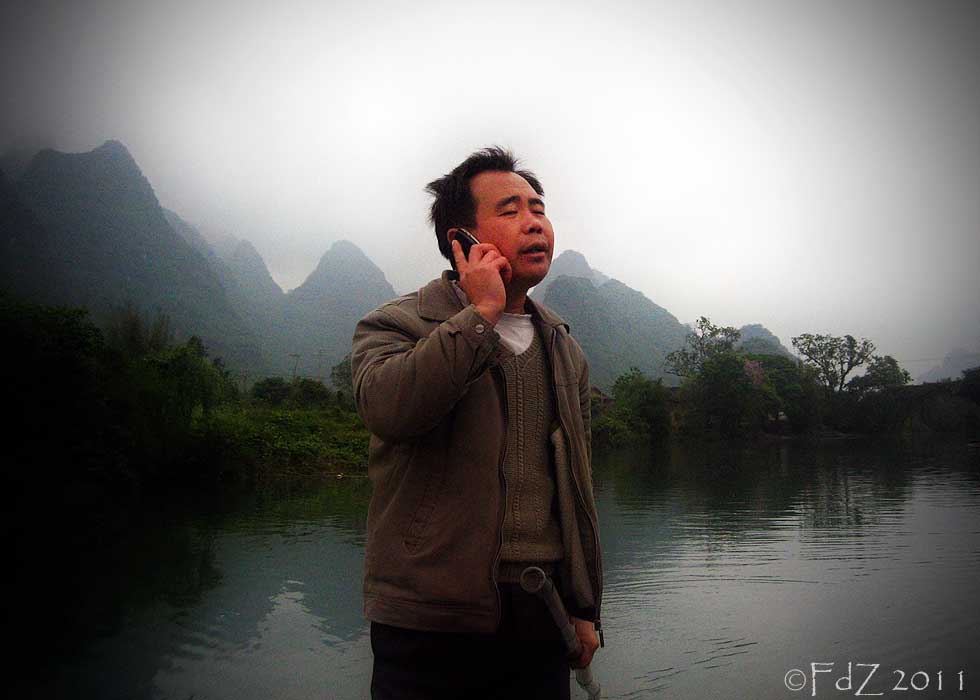
These days you rarely walk the length of a town block without seeing a person walking with a cell phone plastered to his or her ear.  Everyone in China – from CEO to driver – is busy.  On the phone.  

Bride & groom, Guangdong, 2006

Face-to-face meetings are blithely interrupted when a cell phone rings, with not the slightest trace of apology.  Your life is in your driver’s hands; all the while his hands are glued to his phone instead of the wheel.  

Even drifting down the little Yulong River on a bamboo raft, our boatman’s burly voice on his phone blasted away our peace and quiet.

Boatman, Guangxi, 2007

It wasn’t always like this.

One morning about 25 years ago, in my early trade consultancy days, my partner and I took the earliest train from Shanghai to Hangzhou to visit a dial caliper factory on behalf of our British client. It was customary in those days for the translator of the factory to greet us at the train station (or airport, as the case would be), but this particular morning, scanning the hustling crowd of bodies in blue Mao suits and black heads all cropped short, we found no familiar face.

There must have been puzzled or searching looks on our faces, because it wasn’t long before a pretty young woman I’d guess to be in her early 20s dressed in the same Mao suit, the same bluntly cut hair as the rest, approached us and asked in hesitant English, “Can I help you?”

We briefly explained the situation and then said, “Perhaps you can help us find a telephone and call the factory?”

“Of course, I will do my best.”

Luck had it that there was a public phone not too far from the station, just across the street. Don’t imagine anything like a telephone booth. In those days this meant an old-style black telephone placed on a tiny wood table outside some commercial establishment, in this case a small filthy private eatery, the kind even I think twice to eat in.

She dialed, found the right person to talk to, spoke a few lines, hung up and turned to us to say, “The factory is only a few minutes from here.  Someone is coming to pick you up.  Please just wait a while.”

We thanked her, with our big western smiles, and then were stunned by her reply. 

“Please don’t thank me.  Today is a very special day for me.  You see, today is the first time I ever use a telephone.  So I must thank you.”

Whew.

Another time, another reality.  But just twenty five years ago.

Every now and then I still wonder what she is doing today.  But whatever it is, I’d bet my last yuan she is carrying a cell phone.

:::

This story joins Our World Tuesday and ABC Wednesday.

July 5, 2011

Y is for Yangshuo

(These are the first paragraphs of a travel article I wrote in 2007.)

Yangshuo has something for everyone.  

For a first time visitor to China, this small town in subtropical Guangxi is a soft landing into an ancient Chinese setting with many of the comforts of home.  For the veteran Asia traveler or resident, Yangshuo, with its proximity to Hong Kong (a mere one-hour flight) and other large urban Asian centers, is a spectacular place just to hang out and unwind for a few days.  

This popular backpackers’ destination since the ‘80’s has more recently been discovered by tourists both domestic and foreign. Yet the crowds still fail to detract from the town’s architectural charms and its serene location amongst green rice fields, gently flowing rivers and mystical karst peaks.


The old part of town is blissfully free of vehicles of any kind, a rarity in China.  That gives the pedestrian unfettered access to the scores of commercial concerns that line the streets from one end of town to the other.  A surprising number of locals serving in the businesses speak passable English; it’s no wonder the place is called “a global village.”  Perfect for those who can’t leave their shopping cravings at home!

 
Shoppers can find souvenirs of minority crafts and antiques (some real, some not);  exquisite embroidered tablecloths; popular Western (often fake but decent quality) branded clothes or very chic Chinese apparel and accessories; hand painted T-shirts or fans; art and calligraphy… and much more, all for still reasonable prices compared to other tourist centers in China.

But you have to bargain. Pretty “pashmina” shawls in a rainbow of colors were initially offered to me for RMB60 a piece; I walked away with ten shawls for RMB150 (under US$20).  Haggle for the fresh fruit sold by the local farmers on the streets, too.


Even the non-shopper can take pleasure in just a relaxing stroll along the marble stoned streets past the 1400-year-old buildings. Then stop to enjoy a great cup of coffee (really!) or a cold pijiu (beer) and a pizza in one of the many Western-style bars, coffee shops and restaurants, many managed by foreigners. 
 

Another day I will show you the exquisite surrounding landscape. If you can't wait, check out my earlier posts here, here and here.

Yangshuo enters the medley of Ys at ABC Wednesday

And this final photo taken early in the morning before the storefronts opened their shutters to show their wares, my favorite today (nicer enlarged) and processed in sepia, is for Sepia Scenes.

Yangshuo, 2007

PS. I am back home in the Philippines and will continue to share local sites as well as my travels around the globe as time permits.

November 13, 2010

Color in a Cave

A spectacular world of stalactites, stone pillars and rock formations created by thousands of years of erosion and carbonate deposits. 

 Guangxi, 2006

The clear colorful reflection in this pool joins the community at James' Weekend Reflections.

But I'm not so very fond of caves, really. Are you?

September 19, 2010

Glass House Bridge

One would cross this glass house bridge I captured at twilight to get to a tiny island in the middle of a small, probably man-made, lake. The bridge can be found in a pretty park in Guilin, a city most famous for its location among the picturesque karst hills you see in the distance (and better seen here, here and here).

Guilin, 2007

Many more bridges from around the world can be found at the links hosted at Louis' Sunday Bridges

August 29, 2010

The Finest Scenery under Heaven

Generations of Chinese poets and painters have called Guilin “the finest scenery under heaven.
Traditional Chinese brush painting

During his visit to the area in 1979, Henry Kissinger, US Secretary of State at the time, commented: "Before l came here l thought the Chinese landscape paintings were but the romantic creation of painters, but now having seen the landscape… l realize they are realistic genuine portrayals.

There isn't much that can surpass the serenity of softly floating down the Yulong (Meeting the Dragon) River on a simple bamboo raft (which you can see here) surrounded by magnificent limestone pinnacles veiled in a gentle mist… “merrily, merrily, merrily, merrily, life is but a dream.”

Guangxi, 2007

This bridge with a lone bicyclist is posted for Louis la Vache's Sunday Bridges and Aisha's Scenic Sunday. The link will take you to links to other bloggers posting amazing bridges and scenes around the globe.

August 22, 2010

Minority Woman with Baskets

This minority woman crossing the footbridge may have been collecting the day's vegetables in plots across this river from her riverside town, much like many generations of her tribe before her. 

Longshen Town, Guangxi, 2007

Posted for Louis la Vache's Sunday Bridges. Click the link for links to may more interesting bridges around the world.

July 25, 2010

Replica Bridges

Theme parks generally get the thumbs down from me; just not my cup of tea.

Yet this model of a minority village set in the picturesque province of Guanxi with the karst hills providing a dramatic backdrop was a pretty as well as an informative place to take our company team on our annual outing some years ago. Today I post a couple of views of typical Chinese bridges they replicated for Louis La Vache's meme Sunday Bridges.

 Guanxi, China, 2006

The same foot bridge seen from inside a building:


And another smaller bridge:


Click the link above to get to more links of bridges around the world.

[Click on the photo to see a larger view of it.]

July 3, 2010

Reflections on Yulong River

Karst hills along the Yulong River, China, 2007

This photo I took on an Easter weekend getaway to Yangshuo, a charming tourist town near the better known city of Guilin in Guangxi province, is posted to join the internet meme Weekend Reflections hosted by blogger James. For a list of other participating blogs, click HERE.