Showing posts with label ABC Wednesday. Show all posts

December 4, 2012

Kalinga - Part VII - Community Unity

There is no shortage of community unity in Buscalan. 

Tending their fields, raising their children, preparing their food, celebrating their rites of passage... most of these village activities are family and community affairs.


Dried tobacco leaves
Taddok dance
Boiled pork shared with whole village

Listen to the beat of the gangsa gongs as the women gracefully make the simple steps of the taddok dance. This video was taken by our travel mate Bruce.


This is the seventh of my Kalinga series from my recent visit into the Butbut tribal village of Buscalan, high up in the terraced mountains in the north of the Philippines. You'll find more about these former headhunters and their amazing tattoos in my earlier posts.

I link with Our World and ABC Wednesday, where the letter of the week is U for Unity.

October 31, 2012

Kalinga - Part VI - Portrait of a Proud People

I'm not yet done with telling visual stories of our amazing visit to Barangay Buscalan, high up among the rice terraced mountains of Kalinga province.

The people of Buscalan may be materially dirt poor, but that they are a proud people with a rich culture is equally apparent. 

And, I must add here, their sincerely warm hospitality belies their history as ferocious head hunters.

Let my portraits do the talking.


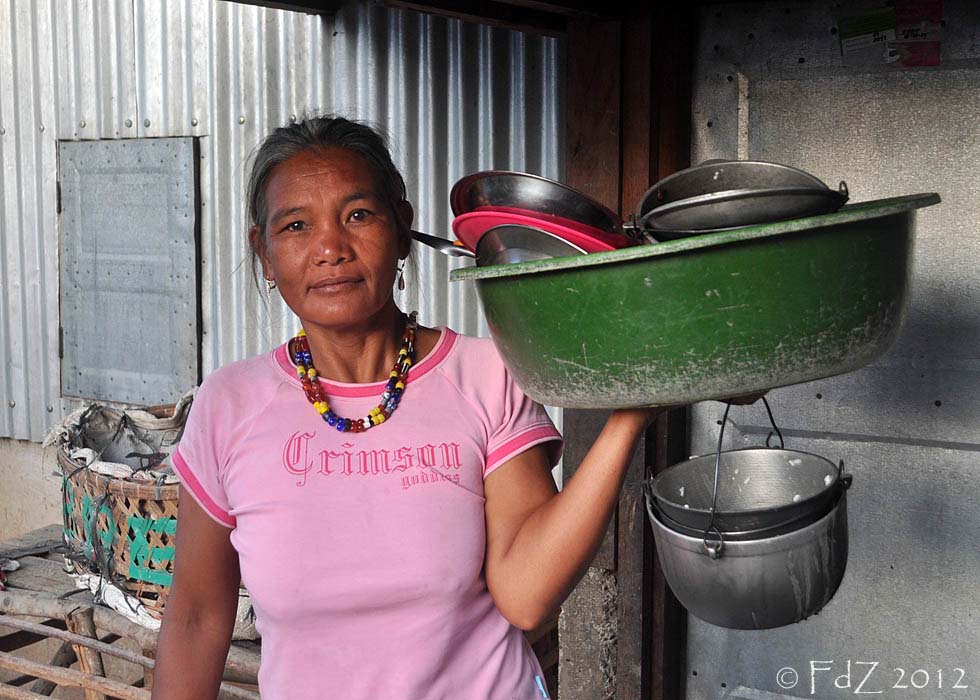
Virgie was our able translator


Ti-A and her husband Charlie, barangay leader, were our generous hosts


Ti-A's mother kindly shared her home with us for the night

 Buscalan, Kalinga, 2012

These portraits of a proud people are my contribution to ABC Wednesday where the letter of the week is P.

I am also pleased to share with you (with his permission) this superb video put together by travel mate Jeremiah (shown in Part II with Whang Od). Jeremiah and his three friends hailed from Cebu, and all of us met in Tuguegarao for the start of our journey together. See Part I.


Whang Od from djsparechange on Vimeo.

Part VII still to follow.

October 24, 2012

Kalinga - Part IV - Old Tattooed Women

From the mountains we derive our strength,
the rivers our peace, the valleys our hopes,
and from the skies, the wisdom of our ancestors.
~ Kalinga proverb

The last traces of a centuries-old tradition are soon to be lost to humanity.

The Butbut, when still a fierce warring tribe, celebrated the victories of its headhunting warriors with intricate and meaningful body tattoos. Since the heads of enemies are no longer hunted and it is considered an affront to the elder warriors to get tattooed without the bravery proven in tribal wars, very few men get the traditional tribal tattoos in modern times. The fully tattooed men of Buscalan have all died; and I've heard a handful of old men still survive in the province, but we did not meet them.

Besides the national treasure Whang Od (Part II), we did, however, meet the last old tattooed women of Buscalan, high up in the rugged rice terraces of Kalinga (Part I). The batok (tattoos) of these women were not only designed to enhance their beauty and confer status, they also symbolize their female strength and stamina.

These are my some of my favorite portraits. 

This first woman was the oldest of the tribe, a young 103! All the rest were in their 80s and 90s. Several of them were blind or near-blind.


Kalinga, 2012

These old women readily removed their tops to show us their intricate tattoos. Sadly aware that they were the end of a tradition, they patiently posed for us to chronicle their beauty and grace with our cameras. 

Today's younger Kalinga women have a different sense of aesthetic and few are willing to undergo the pain of the process of tattooing.

I end this post with another quote from Lars Krutak
For the Kalinga, nature has always provided a kind of talisman against unbridled change and a link to ancient traditions because it is constant, perpetual, and eternal. Nature was the basis from which many Kalinga cultural traditions sprang and none more so than the ancient art of tattoo. Tattooing was a natural language of the skin that gave voice to the ancestors and their descendants who attempted to emulate them by sacrificing their own bodies to make them more lasting and sacred.
Sadly however, Whang Od’s generation may be the last to wear these indelible symbols so closely tied to nature, Kalinga identity, and the ancestral past. And like the marauding headhunters who once roamed the mountains and forests of Kalinga only a century ago, these elders are the last vestiges of an era that will soon fade away into memory; but one that will always remain in story, song, and above all spirit.
___

It's been too long since I joined the fun crowd over at ABC Wednesday! The letter of this week is O - and from me that's O for old.

Oh, and I'm still planning a Part V... stay tuned...

January 11, 2012

Z is for Zhongshan

For the last letter of Round 9 at ABC Wednesday I'm bringing you to a favorite market of mine, the Zhongshan Antique Furniture Market.

When I first visited this market many years ago, there was no fancy gate like this to greet us and no real buildings, just a small loose group of vendors in makeshift structures selling antiques collected in villages near and far. (It's a pity I did not carry a camera in those early days!)


The market has expanded significantly over the decades and today it is an enormous formal complex of vendors selling antiques real and reproduced. Not only furniture, but you can find garden decor, home decoratives and knickknacks here... in stone, metal, wood and ceramic.

I am going to let my photos tell you the rest of the story.


Zhongshan, Guangdong, 2009

The red bubble between the City of Zhongzhan and Macau marks the spot where this market is.

January 4, 2012

Y is for Year

We are a few days into 2012 and this post is a brief peek into how Filipinos celebrate the arrival of the New Year. Two words might suffice, really: deafening and dangerous.

Firecrackers, fireworks and other noisemakers are key to bringing the new year in with a bang. For days before the midnight transition from old year to new and for a day or two after still, the eardrum bursting sounds of snap, crackle, pop, whizz, fizz and BANG! permeate the air, along with lung-busting (and airplane diverting) smoke.

A traditional belief I suspect was adopted from the Chinese holds that the cacophony drives off evil spirits, thereby ensuring a bountiful and blessed new year.

Despite legally banning the larger explosives and annual attempts to forewarn the public of the dangers of fireworks through information campaigns, each year many hundreds of casualties and a few deaths are reported throughout the nation. Many would like to see a total ban on all fireworks, but there is still a massive resistance again such a move.

My photos were taken last week in Dumaguete, where vendors in makeshift stalls along the street saw a brisk business for their fiery wares.


Dumaguete, 2011

I am linking to ABC Wednesday where the letter is Y and to Signs, Signs.

December 21, 2011

W is for Wish


These heartfelt wishes are for my blogging friends at ABC Wednesday, Alphabe-Thursday, Weekend Reflections and any other friendly bloggers dropping by. CHEERS!

December 13, 2011

V is for Vandalism

Vandalism can be simply defined as "willful or malicious destruction of public or private property." Few would argue that smashing windows or burning cars is criminal behavior, no less than trespassing or burglary, subject to prosecution and punishment.

Yet when it comes to graffiti - writing or drawings scribbled, scratched, or sprayed illicitly on a wall or other surface in a public place - a debate has raged for centuries.

Bucharest, 2011

On one end of the spectrum are those who argue that graffiti can be an artful expression of rebellion, an acceptable form of individual, political or social commentary by the powerless and marginalized.


Hardliners on the other end firmly believe that graffiti, totally unlike commissioned or requested wall/public art (like yesterday's post), is an unwelcome sign of anarchy, a loathsome act of disrespect for property, a crime, and certainly never to be called art.


What do you think? Can we discuss artistic or social merit when looking at the graffiti in these photos I took in Bucharest earlier this year? Is there a middle-of-the-spectrum position? Or is it all merely vandalism, period?


Of course graffiti filled spaces are nothing unique to Bucharest. Still I see more of it throughout Europe than in North America, and even less in Asia.

What role does culture play in the acceptance or tolerance of graffiti? I don't know; I'm asking.

(Ne Travaillez Jamais = Never Work)

Municipalities and businesses bear significant costs to clean up graffiti (when they can afford to do so at all). So I wonder whether it would do any good to provide clean and accessible walls for people to come and express themselves (sort of like the ill-fated Democracy Wall in Beijing in 1978)? Or is the illicitness of the vandalism an intrinsic part of the message? Again, just asking.

(La Vie Est Ailleurs = Life Is Elsewhere)

I'm linking with the blogging communities at Our World Tuesday and ABC Wednesday with the letter V.