February 6, 2011

Bridge for My Mother

Yesterday was the first death anniversary of my mother. I reflect on our special time together in her last months on the Sunshine Coast of BC before she crossed the final bridge. She too loved beauty in nature, so today I post a photo of a bridge I took on a walk with my nephew in a small park last year.

Sunshine Coast, 2010

I hope that bridge took you to somewhere beautiful, Betti.

Linked with Louis' Sunday Bridges.

February 5, 2011

Lights and Lines Reflected

Hong Kong is a shopper's paradise. In the days preceding a holiday, the malls are extra busy.

In this shot of people on the escalators taken a few weeks ago, I can hardly make out what is real and what is reflected. Thought it might be perfect for James' Weekend Reflections. Enlarge it and tell me if you think I've gone over the top.

Hong Kong, 2011

February 4, 2011

[SkyWatch] Don't Let the Sun Go Down on Me

Before you go any further, unless you're in a rush or dislike music, right click HERE to open a new tab, crank up your speakers and start listening to this great Joe Cocker rendition of Don't Let the Sun Go Down on Me. I'm listening now as I write. When Joe starts singing, come on back to this tab and enjoy the skies I saw earlier tonight from a second-floor window.

These skies are not going to break your bank of superlatives, but the soft colors really appeal to me. Maybe one day I will decorate a room in this palette. Can you see it? Pretty, isn't it?


Manila, 2011

And something else I can tell you. I live in the tropics and our seasonal changes are a bit lame compared to what you may experience. But today I really noticed how bare many of our trees are. That's about the extent of our winter.

These photos are SOOC except for a bit of cropping, downsizing and adding my copyright.

Linking at SkyWatch Friday where you'll find spectacular skies from around the world.

February 3, 2011

Q is for Quilt

Since 1920 when the Soviet Union annexed Kazakhstan, many families have fled that country to Mongolia. Today, nearly 12% of the multi-cultural population of the western Mongolian aimag (province) of Hovd are Kazakhs. Traditional Kazakh culture here is quite intact and differs in various ways from the Mongolian. Most evidently, they still speak their own Turkic language, but also the Kazakh gers (yurts) are taller, wider, and more richly decorated than the Mongolian version.

Several times over our six days in Hovd we were treated to warm Kazakh hospitality and enjoyed up close views of family life in a ger.  In each of the Kazakh gers we entered, the entire round wall was covered with stunning embroidered tapestries called dream quilts.

Today I show you the wonderful quilt work of one Mongolian Kazakh woman.  In an earlier post here you can see her open her gate to welcome us into her ger. These photos with her various quilts were taken inside her ger.


Hovd, 2007

Cotton and wool threads are used for the extensive embroidery work and fine plush/velvet fabric is then used to make a border typically around three of the sides. Not shown in my photos is that the bottom edges of most quilts are left unfinished. There are two explanations  given. The first is  that life does not end and this is expressed by leaving room for a continuation of  the embroidery. The second, more mundane reason, is that since the bottom is tucked under a rug, table or bed anyway, why  finish it?

If you're into quilting, the colorful details are much better seen with photos enlarged:


In this final photo you can see the quilter with her mother, daughter and grandson - four generations of Mongolian Kazakhs.


Linking at Jenny's Alphabe-Thursday where you will find others playing with topics starting with the letter Q.

February 2, 2011

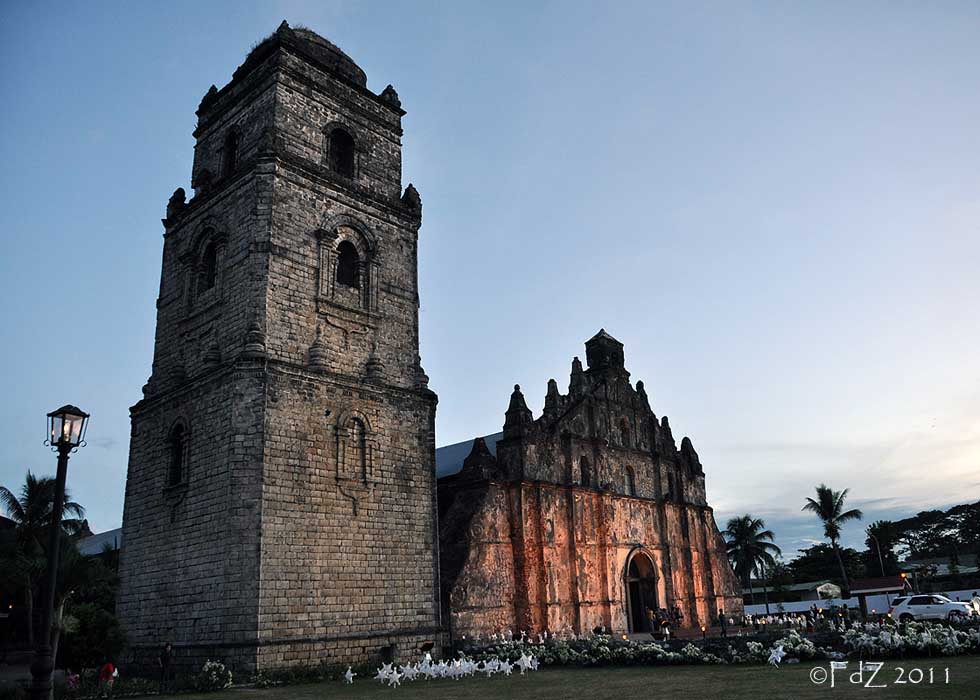
C is for Church

One of the most distinctive experiences I’ve enjoyed in my travels is a private dinner on the front steps of a church. And not just any church, but the gorgeous Paoay Church in Ilocos Norte, the northernmost province in the Philippines.

Ilocos Norte, 2010

Known also as San Agustín of Paoay, it is one of four churches built by the Spanish in the late 16th century that was placed on the Unesco World Heritage list in 1993 for its unusual style of architecture. A fusion of Oriental, Gothic and Baroque influences created unique structures characterized by a separate bell-tower and strong buttresses able to withstand repeated earthquakes.

As described on the UNESCO site:
The Church of San Agustín at Paoay is the most outstanding example in the Philippines of 'Earthquake Baroque'. Fourteen buttresses are ranged along the lines of a giant volute supporting a smaller one and surmounted by pyramidal finials. A pair of buttresses at the midpoint of each nave wall have stairways for access to the roof. The lower part of the apse and most of the walls are constructed of coral stone blocks, the upper levels being finished in brick, but this order is reversed on the facade. The massive coral stone bell tower, which was added half a century after the church was completed, stands at some distance from the church, again as a protection against damage during earthquakes.


Construction of the church started in 1704 and was completed in 1894 by the Augustinian friars. The bell tower next to the church dates to 1793 and served as an observation point of the Katipuneros during the Philippine Revolution in 1896 and later by the guerrillas during the Japanese occupation.

It’s no wonder Paoay Church was also declared a national treasure.

As you can see from the photos, we arrived at the church after the sun was down, and while our party explored the grounds, the lights were turned on and the tables were set up for us. It was just a few days after Christmas, so the tree was still standing.


This post is linked with ABC Wednesday where the letter of the week is C. Go check out how other interesting C posts.

February 1, 2011

Red for Good Luck

Red is the color for good luck and success for Chinese everywhere and over the weeks of the lunar new year celebrations, China is bathed in the color.

Tomorrow is Chinese New Year's Eve and Thursday is the first day of the Year of the Rabbit. A couple of weeks ago when I was in China, on the streets and in the stores and malls red decorations were coming out on display. Makeshift shops on the streets selling red new year products were starting to pop up like mushrooms. 

 Chinese knots
 Chinese lanterns, calendars, red pockets and calligraphy posters
 Guangdong, 2011
 Mall decoration
 
 Even red underwear for good luck

I wish you and yours 
Kung Hei Fat Choy!

Today I link with MyWorld Tuesday and Ruby Tuesday.